
Advocacy Updates
The latest on our advocacy efforts.
Read the highlights of CICC’s ongoing advocacy efforts across Canada for the month of August .
Last updated August 24, 2026.
Federal Updates
Earlier this month, CICC submitted to the Finance Canada pre-budget consultations. The submission urged the federal government to take action in Budget 2026 on carbon and excise tax rebates, relief from credit card interchange fees, and the contraband nicotine crisis.
See our submission here.
To support our continued push on contraband nicotine, we are working with KPMG and EY on two research reports to generate earned media and further highlight the issue with federal decision-makers. The KPMG illicit pouch market analysis is in the final stages, and we anticipate launching early in the Fall to provide concrete data points on the financial toll of contraband.
This issue remains a top priority for CICC due to the rapid influx of illicit, unauthorized high-dosage nicotine pouches that bypass federal regulations.
We also continue to engage senior staff in the Prime Minister’s Office and the office of the Secretary of State (Finance) on the carbon tax and federal excise tax file.
Our message is simple: we want a mechanism introduced in the upcoming budget to reimburse operators for losses caused by government policy changes.
CICC is actively prepping for the resumption of the House of Commons by launching a targeted advocacy campaign in Ottawa.
We have secured printed transit shelter ads in the Parliamentary Precinct and three digital billboard ads on Sparks Street for September to catch returning MPs and caucus members.
Atlantic Updates
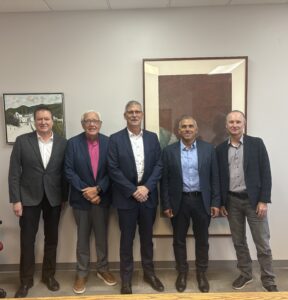
In mid-August, CICC VP, Mike Hammoud and local CICC retailers, had their first meeting with Newfoundland and Labrador Minister of Finance Craig Pardy to discuss several key issues impacting retailers across the province.
A significant part of the discussion focused on the crisis issue of contraband tobacco and the negative impact it is having on communities, the province, and legitimate retailers. Minister Pardy was up to speed on the causes, and very receptive to our concerns, he acknowledged the seriousness of the issue. The Minister indicated that the government is looking at potential solutions. The Minister also confirmed the Premier’s discussed a joint Fed/Prov approach at their most recent meeting.
Mike and the retailers also discussed the increasing costs retailers face in selling beer products; and made a request for an increase in retailer margins. To support the ask, Mike shared with Minister Pardy that Newfoundland and Labrador has had the highest store closure rate in the country; and the need is real for additional margin support to help offset rising operating costs and support the long-term viability of the retail network.
Overall, it was a very positive and productive first meeting with Minister Pardy.
In Nova Scotia, work continues to keep the concept of broader sales of beer, and RTD’s in the convenience channel alive. Meetings are in the works for September, with a goal of finding mutual agreement to test concepts – that have already been proven in Ontario, Quebec, Newfoundland, and Labrador.
PEI has announced that they are looking at making changes to their Beverage alcohol policies. Mike Hammoud has secured a meeting in late September to pitch CICC’s case.
At an August 10 hearing, the New Brunswick Energy and Utilities Board considered whether the province’s maximum retail margin for self-serve regular unleaded motor fuel should be reduced. Board consultant Gardner Pinfold recommended a 0.73-cent-per-litre, or 6.9%, reduction, based on 2024-2025 data showing operating costs rising only 0.6% while fuel volumes increased 8%. The hearing established, however, that retailers’ actual operating costs had not declined. The lower cost per litre resulted from spreading slightly higher costs over substantially greater sales volumes.
Questions also emerged about how representative that 6.9% figure was. The lowest-volume group of retailers showed an unusually large decline in wages and benefits and accounted for roughly three-quarters of the overall reduction in cost per litre. When that group was removed in an analysis requested during the hearing, the decline fell from 6.9% to just 1.8%. Gardner Pinfold nevertheless maintained its original recommendation, leaving it to the Board to decide how much weight to place on the differing results.
The CICC and CEMA urged the Board to maintain the existing margin. Their central concern was that the recommended reduction was driven largely by an exceptional increase in 2025 fuel sales, the largest year-over-year provincial increase in approximately 38 years, without evidence explaining why it occurred or whether it represents a lasting change in market conditions. Wholesale/retail interveners Clark Oil and the Scholten Group supported maintaining the current margin, citing uncertainty in the data and potential impacts on smaller and rural retailers. The Board must now decide whether the evidence demonstrates a sufficiently durable change in retailer economics to justify a reduction.
Quebec Updates
CICC is preparing to take an active role in the provincial election campaign, which will begin in the coming days and conclude on October 5. With five political parties competing for attention and numerous issues vying for candidates’ and the media’s focus, CICC’s efforts will aim to ensure that the concerns of convenience retailers are clearly heard.
Key Messages
- Going forward, no new regulations without consultation with the industry.
- While the industry contributes approximately $7 billion in taxes annually, convenience stores are not asking for special treatment. Rather, they are asking for recognition of the growing regulatory burden they face and for political parties to commit to systematically consulting the industry before introducing any new regulations that could impact their operations.
Approach
- Letter and questionnaire to the five political parties
- Send all five parties a letter outlining the sector’s concerns and priorities, along with a questionnaire designed to secure clear commitments on the issues that matter most to convenience retailers.
- Local action in eight targeted ridings
- To maximize the campaign’s impact, CICC will focus on eight key ridings, where local initiatives will be organized with the support of convenience retailers in the area.
- Local candidates will be approached directly and asked to take a position on the sector’s key priorities.
- Engaging local media
- Local media will be invited to meet with convenience retailers and see firsthand the impact of the regulatory burden on their businesses.
- Press conferences and media events will be organized in selected ridings, with candidates invited to participate and share their commitments.
Ontario Updates
CICC submitted a formal written response to the Ministry of Finance (MOF) regarding Ontario’s proposed manufacturer’s licensing and off-premise retail regime.
We have received positive signals about our feedback and will continue to ensure the Ontario government addresses our primary concerns about minimum shelf-space requirements should it proceed with standalone off-premise craft outlets.
We continue to engage the Premier’s Office, LCBO and the Ministry of Finance on the challenges with the proposed convenience wholesaler program. The LCBO has refused to offer a wholesale discount, forcing wholesalers to pass even more costs onto convenience retailers and making the current distribution structure economically unviable.
In responding to the provincial budget’s contraband consultation, CICC is looking to partner with local police associations to emphasize the law and order perspective of contraband nicotine.
Our advocacy focuses on securing the deputization and training of local peace officers to conduct contraband searches without waiting for MOF authorization, as well as allowing local police forces to retain proceeds of crime to incentivize deeper investigations into organized crime syndicates.
Western Canada Updates
The Latest
Get Certified.Sell Responsibly.
Ensure your employees are certified to responsibly sell alcohol with CICC’s ID Please SABR course. CICC Members receive preferred pricing.